

Textile PLI Scheme 2026: Extension, Eligibility & Benefits
October 28, 2026
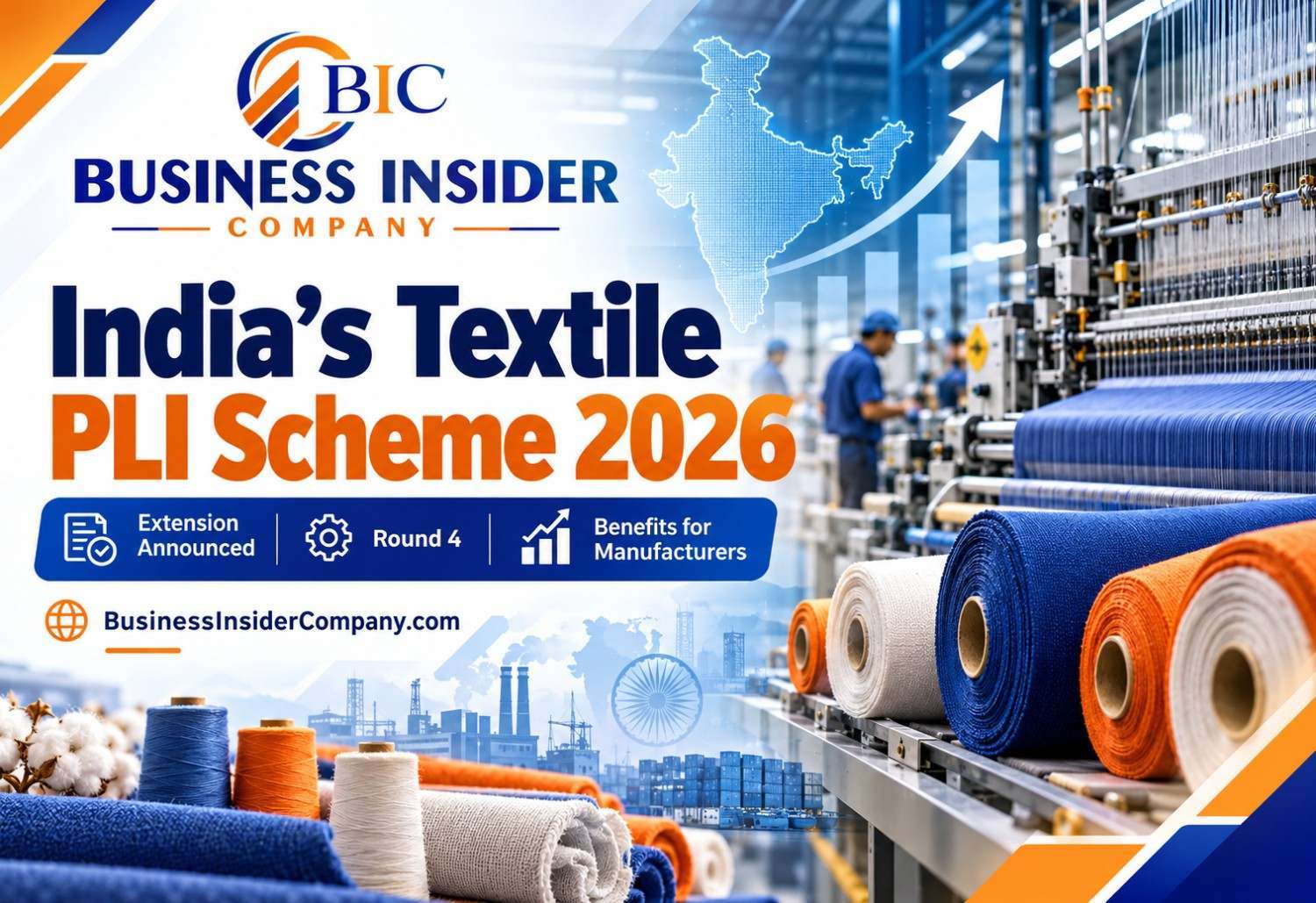
Textile PLI Scheme 2026: Extension Announced, New Eligibility Rules and Benefits for Indian Manufacturers
India's textile manufacturing industry has received an important policy update. The Ministry of Textiles announced on October 28, 2026, that the Textile PLI Scheme 2026 will reopen for Round 4 applications, with revised eligibility conditions and an extended scheme tenure for newly approved participants.
Under the announcement, applications will be accepted from November 1 to December 31, 2026. The government has also reduced the minimum turnover requirement under Part 2 of the scheme from ₹200 crore to ₹100 crore and extended the scheme tenure to FY 2033–34 exclusively for approved Round 4 applicants.
These changes could create new opportunities for eligible man-made fibre (MMF) apparel producers, fabric manufacturers, technical textile companies and expanding manufacturing enterprises.
For manufacturers evaluating investment in India's textile industry, understanding the scheme's conditions is essential.
What Is the Textile PLI Scheme 2026?
The Production Linked Incentive (PLI) Scheme for Textiles is a central government initiative designed to encourage investment and large-scale manufacturing in selected textile segments.
Originally approved in September 2021 with a financial outlay of ₹10,683 crore, the scheme focuses on strengthening domestic production and improving India's competitiveness in international textile markets.
Unlike a conventional subsidy available to every textile business, the programme links incentives to qualifying manufacturing investments and production performance.
Its three major focus areas are:
-
MMF Apparel: Clothing manufactured from eligible man-made fibres.
-
MMF Fabrics: Specified synthetic and artificial-fibre fabrics.
-
Technical Textiles: Specialised textiles used in industrial and functional applications.
The scheme aims to encourage manufacturing expansion, generate employment, increase value addition and develop stronger domestic supply chains.
In 2026, the government's renewed emphasis is on enabling more qualified manufacturers to participate while maintaining the scheme's investment and performance requirements.
Textile PLI Scheme 2026: Latest Extension Announcement
On October 28, 2026, the Ministry of Textiles officially announced the reopening of the PLI application portal under Round 4.
This followed earlier media reports suggesting that an extension was under consideration. The government announcement now confirms several important changes.
1. Round 4 Applications Open November 1
Eligible manufacturers can submit applications through the official Textile PLI portal between November 1 and December 31, 2026.
Companies considering participation should review the notified product categories and relevant scheme guidelines before investing or submitting applications.
2. Scheme Tenure Extended to FY 2033–34
The government has extended the scheme tenure to financial year 2033–34 specifically for companies approved under Round 4.
This is an important distinction: the announcement does not automatically extend every earlier participant's incentive period to FY 2033–34.
The longer tenure may provide new applicants with additional time to develop manufacturing capacity and scale eligible production.
3. Lower Turnover Requirement for Part 2
The minimum turnover criterion under Part 2 has been reduced from ₹200 crore to ₹100 crore.
This adjustment is intended to allow a broader range of medium-sized and growing manufacturing companies to consider participation.
4. Migration Opportunity for Existing Applicants
Companies approved in Rounds 1, 2 or 3 that have neither claimed nor received an incentive may be eligible to migrate to Round 4.
Such migration is subject to withdrawing their earlier applications and complying with the applicable requirements.
Textile PLI Scheme 2026 Eligibility Criteria
Manufacturers should examine both the latest Round 4 announcement and the previously amended scheme provisions.
The October 2025 amendments had already reduced the minimum investment thresholds to ₹150 crore for Part 1 and ₹50 crore for Part 2.
| Eligibility Factor | Scheme Position |
|---|---|
| Part 1 minimum investment | ₹150 crore under the 2025 amendments |
| Part 2 minimum investment | ₹50 crore under the 2025 amendments |
| Part 2 turnover requirement | Reduced to ₹100 crore for Round 4 |
| Incremental turnover growth | 10% from the second performance year under the amended framework |
| Eligible sectors | Notified MMF apparel, MMF fabrics and technical textiles |
| Round 4 application period | November 1–December 31, 2026 |
| Round 4 scheme tenure | Extended to FY 2033–34 |
Applicants must check the final applicable guidelines for definitions of investment, turnover, qualifying products, incentive calculations and verification procedures.
Important: A business does not become eligible simply because it is registered as an MSME or operates in the textile industry.
Benefits of the Textile PLI Scheme for Indian Manufacturers
Encouraging New Manufacturing Investment
One potential benefit of the PLI programme is its ability to support the economics of eligible large-scale manufacturing projects.
Investments in production machinery, technology, capacity expansion and quality control can require substantial capital.
A production-linked incentive may improve a qualifying project's financial performance when the company meets all applicable conditions.
However, manufacturers must still assess financing costs, working capital, production demand and commercial risks independently.
Supporting Manufacturing Growth and Exports
India's textile industry includes a large network of yarn producers, fabric manufacturers, processors, garment exporters and specialist technical textile companies.
Expanding domestic capacity in eligible MMF and technical textile products could help reduce supply constraints and improve manufacturing competitiveness.
For export-oriented companies, consistent quality, scalable production and timely fulfilment remain essential.
The PLI scheme does not guarantee export orders. It is a potential support mechanism for qualified production, rather than a substitute for international marketing, product development or compliance.
Creating Opportunities Across the Supply Chain
Although direct incentives are restricted to approved participants, manufacturing expansion can generate demand for related services.
Machinery suppliers, packaging companies, logistics providers, testing laboratories, skilled workers and specialised component manufacturers may find indirect business opportunities.
The extent of these opportunities will depend on actual project execution and market demand.
For MSMEs, supplying larger manufacturers may be a more practical entry point than applying for PLI incentives directly.
Textile PLI Scheme: Government Investment and Employment Data
The Ministry of Textiles reported that 170 companies had been approved under the scheme as of August 4, 2026.
The approved companies were distributed across three segments:
| Textile Segment | Approved Companies |
|---|---|
| MMF Apparel | 43 |
| MMF Fabrics | 38 |
| Technical Textiles | 89 |
| Total | 170 |
The ministry also reported the following performance figures as of March 31, 2026:
-
Actual investment: ₹8,117.64 crore
-
Reported turnover: ₹11,241 crore
-
Employment: 33,427
These actual performance numbers should not be confused with the much larger investment commitments and employment projections associated with approved proposals.
The distinction matters when assessing the programme's economic impact.
Impact on Surat, Gujarat and Other Textile Manufacturing Hubs
Surat is an important textile production and trading centre, particularly for synthetic fabrics, processing and finished fashion products.
The PLI scheme may be relevant to qualifying Surat-based manufacturers planning expansion in eligible MMF fabrics or apparel.
For instance, a fabric producer investing in production technology could examine whether its notified products, proposed expenditure and turnover plans satisfy the scheme's requirements.
The possible impact extends to textile centres in Maharashtra, Tamil Nadu, Madhya Pradesh and other manufacturing states.
However, traditional cotton products, silk sarees, handloom products and ordinary trading activities are not automatically covered.
Manufacturers must verify their specific product HSN codes against the government's notified list.
Retailers and wholesalers should also understand that direct PLI incentives primarily concern qualifying manufacturing activity, not ordinary resale operations.
How Can Textile Manufacturers Apply for PLI Scheme Round 4?
Businesses interested in participating should follow a structured preparation process.
Step 1: Verify Product Eligibility
Identify the exact textile products the company intends to manufacture and compare their HSN classifications with the official notified product list.
Step 2: Review Investment and Turnover Conditions
Assess whether the proposed manufacturing project can meet the applicable capital investment, turnover and performance requirements.
Step 3: Prepare Financial and Project Records
Keep business registration details, project information, financial statements, investment plans and supporting documents ready as required by the official application guidelines.
Step 4: Use the Official Application Portal
Visit https://pli.texmin.gov.in/ and follow the application instructions applicable to Round 4.
Step 5: Monitor Approval and Compliance Requirements
Submitting an application does not guarantee approval.
Manufacturers should review subsequent official communications and maintain the accounting and production records needed for verification and incentive claims.
Challenges Manufacturers Should Consider
Despite the relaxed criteria, PLI participation requires substantial investment and disciplined business planning.
A ₹50 crore minimum investment threshold under Part 2, for example, remains significant for many smaller manufacturers.
Companies must also consider demand uncertainty, raw material price fluctuations, export-market conditions, technological changes and financing costs.
An incentive-driven investment that lacks sustainable customer demand can still become commercially unviable.
Business owners should therefore evaluate the scheme as one component of a broader manufacturing strategy.
Future Outlook for India's Textile Industry
The Round 4 announcement signals continued policy support for India's MMF apparel, MMF fabrics and technical textiles sectors.
Lowering participation barriers may encourage additional investment proposals, but the actual economic impact will depend on project approvals, capital deployment, production growth and incentive disbursements.
The extended tenure until FY 2033–34 provides approved Round 4 applicants with a longer policy horizon.
BusinessInsiderCompany.com will continue examining how such policy changes affect Indian manufacturing, business investment and industrial development.
For textile entrepreneurs, the immediate priority is understanding the eligibility framework and preparing applications before the announced deadline.
Frequently Asked Questions About Textile PLI Scheme 2026
1. What is the Textile PLI Scheme 2026?
It is a government production-linked incentive programme for eligible manufacturers of MMF apparel, MMF fabrics and technical textiles.
2. Has the Textile PLI Scheme been extended in 2026?
Yes. On October 28, 2026, the government announced an extension to FY 2033–34 exclusively for approved Round 4 applicants.
3. When will Round 4 applications open?
Applications are scheduled to open on November 1, 2026, and close on December 31, 2026.
4. What is the minimum investment required?
Under the October 2025 amendments, minimum investments were reduced to ₹150 crore for Part 1 and ₹50 crore for Part 2. Applicants should verify the applicable Round 4 conditions.
5. What is the new Part 2 turnover requirement?
The government has reduced the minimum turnover criterion for Part 2 from ₹200 crore to ₹100 crore.
6. Can MSMEs apply for the Textile PLI Scheme?
Yes, qualifying MSMEs may participate if they satisfy the relevant manufacturing, investment, turnover and other eligibility requirements.
7. Are saree manufacturers eligible for Textile PLI incentives?
Only if their manufacturing activity and specific products meet the notified scheme conditions. Being a saree manufacturer alone does not establish eligibility.
8. Where can manufacturers apply online?
Eligible companies can use the official government portal at https://pli.texmin.gov.in/.
Conclusion
The Textile PLI Scheme 2026 Round 4 announcement introduces an extended tenure, a reduced Part 2 turnover requirement and a new application window for eligible Indian textile manufacturers.
These developments may support manufacturing expansion and investment in selected MMF and technical textile categories.
However, prospective participants must examine the financial commitments, eligible product classifications and compliance requirements before applying.
For further analysis of Indian industry, manufacturing developments and business opportunities, explore BusinessInsiderCompany.com.
Official Sources and References